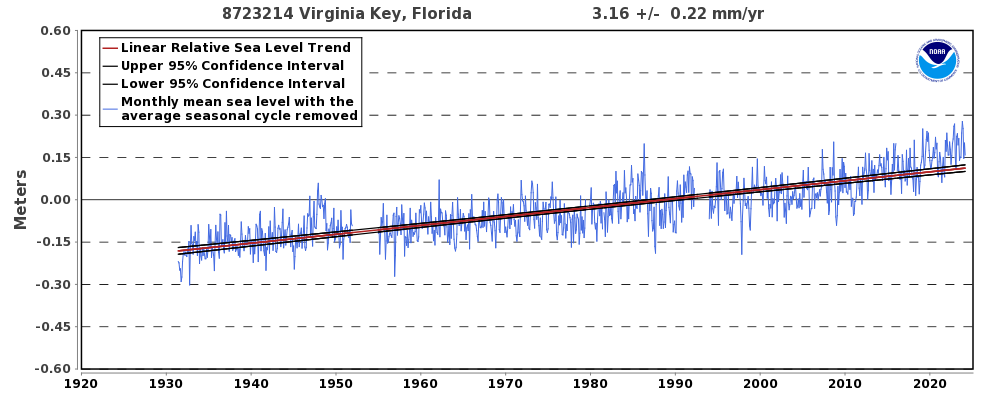
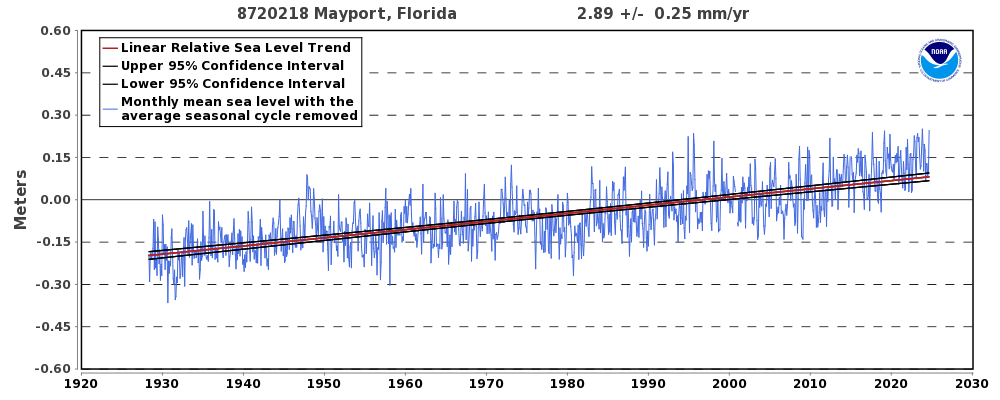
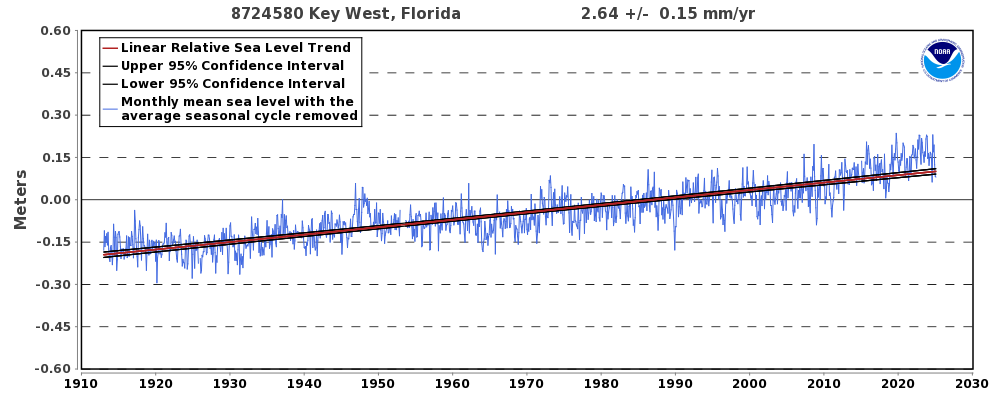
All your plots consistently show an ocean level rise of 0.3 meters (about 1 foot) since 1930. I don't think there's been a world wide trend of land masses lowering if that's your reason for handwaving it away. Even your cherry-picked Vietnam plot shows a rise of 0.1 meter in the last 30 years. You can't just dismiss decades of data because you don't like what it shows.Cal88 said:calpoly said:Do you understand the difference between local and global sea levels. Of course not, it would ruin your narrative.Cal88 said:
The subject of the debate here is pretty simple: the allegation that there was a significant increase in the rate of sea level rise in Florida (or elsewhere) over the past several decades,
The most accurate, reliable and consistent data from historic tidal gage stations measurements as compiled by NOAA establish beyond any doubt my assertion that there was no significant change in the rate of sea rise:
https://tidesandcurrents.noaa.gov/sltrends/sltrends_states.html?gid=1238
https://tidesandcurrents.noaa.gov/sltrends/sltrends_states.html?gid=1238
Do you even realize that all oceans and seas that aren't landlocked are connected? The variations from station to station are due to differences in local movements of land mass over time. However, if there was a recent increase in sea level rise rates, you would have seen that pattern in pretty much all tidal gage stations across the world. But you don't!
I have a background in data analysis and understand how you can construct a rise in sea level rates narrative by combining different data sets with different time spans. For example, the aggregate of these two charts will misleadingly show a significant increase in the rate of sea rise from 1980 on, while individual chart clearly don't:
This is how for instance Michael Mann was able to drylab his famous hockey stick chart.
That is why you can't debunk local tidal gage charts that go a century back, they are all consistently linear, which negates the notion that the rate sea level rise is increasing. The random error patterns are very consistent across time (their data set is homoscedastic).


Nice attempt to derail the thread with an unrelated topic, by the way.