Donut Labs battery - global energy overhaul?

1,368 Views | 32 Replies | Last: 16 days ago by concordtom
concordtom
How long do you want to ignore this user?
13 days ago:

Introducing Donut Battery: the world's first all-solid-state battery in production vehicles.

Available now at gigawatt-hour level production capacity to OEMs world-wide, and already powering the upgraded Verge TS Pro motorcycle shipping to customers.

Donut Battery is now also powering heavy transport industry through Cova Power's smart trailers, and it's natively integrated into a new EV skateboard platform available to OEMs today.

Coming in various sizes and formats, Donut Battery is suitable for use cases from SUVs to supercars and from drones to heavy machinery and even stationary energy storage.

A truly no-compromise all-solid-state battery engineered for real-world use:

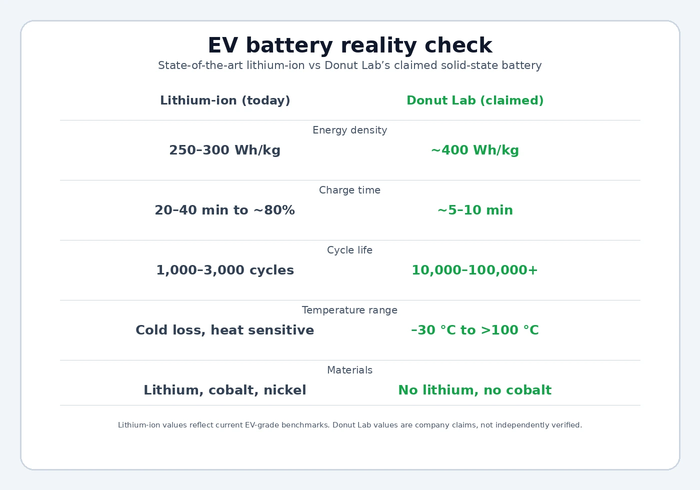
400 Wh/kg energy density
Five-minute full charge
Designed for up to 100,000 cycles
Extremely safe
Made of globally abundant materials
Over 99% capacity retained in -30 degrees celsius
Lower cost than lithium-ion

This is the moment combustion stops competing and starts becoming irrelevant.


Learn more: donutlab.com


concordtom
How long do you want to ignore this user?
Then they appeared at CES (Consumer Electronics Show) in Las Vegas and everyone is going nuts.

This article title in the link alone states it clearly enough: Change The World

https://electrek.co/2026/01/14/batter-about-change-world-or-make-this-guy-fool/

concordtom
How long do you want to ignore this user?
Various reporters share their stories, interviews with the company.
60 employees, Helsinki.


concordtom
How long do you want to ignore this user?
I don't know why they bother putting this in a motorcycle. I guess that's where they started.
Cars
Semi-truck transportation
Airplane
Marine
Grid- solar/wind storage, demand balancing


concordtom
How long do you want to ignore this user?
Okay, if you get through even a portion of that, you should be able to comment.

The main thing is to understand that compared to the leading batteries (CATL), Donut claims to have:

-3x charge/recharge speeds
-1/10th the charge cycle lifespan
-Smaller energy density per kg
-Materials: not political/climate sensitive
-Operating temperature range, incredible
-NO thermal runaway risk
-CHEAPER

These guys say this solves or beats all that. They claim they can ramp up production easily, and WILL, anywhere in the world.

Basically, these claims are so intense, I'm surprised these guys haven't already been kidnapped, that Trump/Putin/China has not already taken over Finland.
Cal88
How long do you want to ignore this user?
Another reason global demand for oil will drop in the 2030s.
BearlySane88
How long do you want to ignore this user?
Cal88 said:

Another reason global demand for oil will drop in the 2030s.


Not according to OPEC.
https://publications.opec.org/woo/chapter/142/2640

The IEA estimates only a minor drop off from 102 mb/d in 2030 to 100 mb/d in 2045 based off of stated policy changes. If you look at current policy based estimations, the IEA actually sees a growth in oil demand from 102 mb/d in 2030 to 105 mb/d in 2035, 108 mb/d in 2040, and up to 113 mb/d by 2050.
https://iea.blob.core.windows.net/assets/dfe5daf4-dbc1-4533-abeb-fafb1faee0f9/WorldEnergyOutlook2025.pdf

The IEA has also recently walked back some of its more aggressive predictions for oil.
https://cleantechnica.com/2025/12/22/peak-oil-is-not-dead-reviewing-the-ieas-world-energy-outlook-for-2025/

https://www.sightlineclimate.com/research/iea-pulls-the-plug-on-peak-oil
Cal88
How long do you want to ignore this user?
BearlySane88 said:

Cal88 said:

Another reason global demand for oil will drop in the 2030s.


Not according to OPEC.
https://publications.opec.org/woo/chapter/142/2640

The IEA estimates only a minor drop off from 102 mb/d in 2030 to 100 mb/d in 2045 based off of stated policy changes. If you look at current policy based estimations, the IEA actually sees a growth in oil demand from 102 mb/d in 2030 to 105 mb/d in 2035, 108 mb/d in 2040, and up to 113 mb/d by 2050.
https://iea.blob.core.windows.net/assets/dfe5daf4-dbc1-4533-abeb-fafb1faee0f9/WorldEnergyOutlook2025.pdf

The IEA has also recently walked back some of its more aggressive predictions for oil.
https://cleantechnica.com/2025/12/22/peak-oil-is-not-dead-reviewing-the-ieas-world-energy-outlook-for-2025/

https://www.sightlineclimate.com/research/iea-pulls-the-plug-on-peak-oil


70% of global oil consumption is for transportation, with Asia accounting for the largest demand bloc.

The ICE vehicle fleet in Asia and much of the world is gradually being replaced by EVs.

BearlySane88
How long do you want to ignore this user?
Cal88 said:

BearlySane88 said:

Cal88 said:

Another reason global demand for oil will drop in the 2030s.


Not according to OPEC.
https://publications.opec.org/woo/chapter/142/2640

The IEA estimates only a minor drop off from 102 mb/d in 2030 to 100 mb/d in 2045 based off of stated policy changes. If you look at current policy based estimations, the IEA actually sees a growth in oil demand from 102 mb/d in 2030 to 105 mb/d in 2035, 108 mb/d in 2040, and up to 113 mb/d by 2050.
https://iea.blob.core.windows.net/assets/dfe5daf4-dbc1-4533-abeb-fafb1faee0f9/WorldEnergyOutlook2025.pdf

The IEA has also recently walked back some of its more aggressive predictions for oil.
https://cleantechnica.com/2025/12/22/peak-oil-is-not-dead-reviewing-the-ieas-world-energy-outlook-for-2025/

https://www.sightlineclimate.com/research/iea-pulls-the-plug-on-peak-oil


70% of global oil consumption is for transportation, with Asia accounting for the largest demand bloc.

The ICE vehicle fleet in Asia and much of the world is gradually being replaced by EVs.


Even as EVs gain traction, the pace of replacing ICE vehicles remains too slow to dent transportation-related oil use substantially. Global oil demand is forecast to rise by 860,000 b/din 2026.
https://www.reuters.com/business/energy/iea-trims-global-oil-market-surplus-forecast-2026-2025-12-11/

Asia's oil demand growth is projected to remain stagnant at just 1% in 2026, but this still translates to incremental volumes that EVs alone can't fully displace.

Also, not all transportation segments are set up for rapid electrification, limiting the impact on the 70% of oil used for mobility. While passenger cars see EV progress, aviation, shipping, heavy-duty trucks, and buses face technological and infrastructural hurdles that keep them reliant on petroleum. For example, road transportation and aviation are expected to drive much of the medium-term demand increase, adding around 13 million b/d globally between 2020 and 2045, 90% from those subsectors. Even optimistic forecasts suggest oil use for transportation might only plateau or decline modestly after 2026.
https://www.library.hbs.edu/working-knowledge/could-global-demand-for-oil-peak-in-2026

EV adoption in Asia and developing markets is uneven and there are barriers that slow the replacement of ICE fleets. While countries like Vietnam (40% EV share of new car sales in 2025), Thailand (20%), and Indonesia (15%) show it's possible on small scales, these are from low bases, and regional averages are far behind those numbers. Southeast Asia hit just 13% EV sales share in 2024.

Transportation is still over 90% oil-powered globally.
concordtom
How long do you want to ignore this user?
Cal88 said:

Another reason global demand for oil will drop in the 2030s.

A talk I posted here by an environmentalist said that all this talk of crashing oil demand is overblown. His position was that new technologies are definitely coming, but that they are going to be additive to energy sources already in place.

Lemme see if I can find it and post for you. It was compelling.
concordtom
How long do you want to ignore this user?
By the way, do a google search on
canada tariff china ev

Recent news - China had followed US policy with 100% tariff, but just dropped it to 15%, allowing 49,000 vehicles in.

US is going to be the only country buying US made cars one day, and then the dam will burst.
Cal88
How long do you want to ignore this user?
BearlySane88 said:

Cal88 said:

BearlySane88 said:

Cal88 said:

Another reason global demand for oil will drop in the 2030s.


Not according to OPEC.
https://publications.opec.org/woo/chapter/142/2640

The IEA estimates only a minor drop off from 102 mb/d in 2030 to 100 mb/d in 2045 based off of stated policy changes. If you look at current policy based estimations, the IEA actually sees a growth in oil demand from 102 mb/d in 2030 to 105 mb/d in 2035, 108 mb/d in 2040, and up to 113 mb/d by 2050.
https://iea.blob.core.windows.net/assets/dfe5daf4-dbc1-4533-abeb-fafb1faee0f9/WorldEnergyOutlook2025.pdf

The IEA has also recently walked back some of its more aggressive predictions for oil.
https://cleantechnica.com/2025/12/22/peak-oil-is-not-dead-reviewing-the-ieas-world-energy-outlook-for-2025/

https://www.sightlineclimate.com/research/iea-pulls-the-plug-on-peak-oil


70% of global oil consumption is for transportation, with Asia accounting for the largest demand bloc.

The ICE vehicle fleet in Asia and much of the world is gradually being replaced by EVs.


Even as EVs gain traction, the pace of replacing ICE vehicles remains too slow to dent transportation-related oil use substantially. Global oil demand is forecast to rise by 860,000 b/din 2026.
https://www.reuters.com/business/energy/iea-trims-global-oil-market-surplus-forecast-2026-2025-12-11/

Asia's oil demand growth is projected to remain stagnant at just 1% in 2026, but this still translates to incremental volumes that EVs alone can't fully displace.

Also, not all transportation segments are set up for rapid electrification, limiting the impact on the 70% of oil used for mobility. While passenger cars see EV progress, aviation, shipping, heavy-duty trucks, and buses face technological and infrastructural hurdles that keep them reliant on petroleum. For example, road transportation and aviation are expected to drive much of the medium-term demand increase, adding around 13 million b/d globally between 2020 and 2045, 90% from those subsectors. Even optimistic forecasts suggest oil use for transportation might only plateau or decline modestly after 2026.
https://www.library.hbs.edu/working-knowledge/could-global-demand-for-oil-peak-in-2026

EV adoption in Asia and developing markets is uneven and there are barriers that slow the replacement of ICE fleets. While countries like Vietnam (40% EV share of new car sales in 2025), Thailand (20%), and Indonesia (15%) show it's possible on small scales, these are from low bases, and regional averages are far behind those numbers. Southeast Asia hit just 13% EV sales share in 2024.

Transportation is still over 90% oil-powered globally.


That Harvard report is from 2023 already is obsolete, does not account for the fundamental changes in the auto industry coming out of China which only hit the global market very recently.

By 2030, the great majority of the Chinese auto park will be EVs, and countries like Brazil, Australia, Spain, the ASEAN countries will follow that trend 5 years behind. In every country around the world with no trade barriers, EV sales are growing at very fast rates.


^This scenario from one study is a bit too optimistic wrt the timing, but the trend is certainly there.

I didn't say global oil demand is crashing, rather that it is peaking later this decade and will taper off thereafter. That decline will probably be slow because as demand falls, so will oil price, and low oil price will in turn prolong the use of ICE.

However, the writing is on the wall. Battery tech is still not mature and EVs already are more competitive than ICEs in terms of price and performance.
BearlySane88
How long do you want to ignore this user?
Cal88 said:

BearlySane88 said:

Cal88 said:

BearlySane88 said:

Cal88 said:

Another reason global demand for oil will drop in the 2030s.


Not according to OPEC.
https://publications.opec.org/woo/chapter/142/2640

The IEA estimates only a minor drop off from 102 mb/d in 2030 to 100 mb/d in 2045 based off of stated policy changes. If you look at current policy based estimations, the IEA actually sees a growth in oil demand from 102 mb/d in 2030 to 105 mb/d in 2035, 108 mb/d in 2040, and up to 113 mb/d by 2050.
https://iea.blob.core.windows.net/assets/dfe5daf4-dbc1-4533-abeb-fafb1faee0f9/WorldEnergyOutlook2025.pdf

The IEA has also recently walked back some of its more aggressive predictions for oil.
https://cleantechnica.com/2025/12/22/peak-oil-is-not-dead-reviewing-the-ieas-world-energy-outlook-for-2025/

https://www.sightlineclimate.com/research/iea-pulls-the-plug-on-peak-oil


70% of global oil consumption is for transportation, with Asia accounting for the largest demand bloc.

The ICE vehicle fleet in Asia and much of the world is gradually being replaced by EVs.


Even as EVs gain traction, the pace of replacing ICE vehicles remains too slow to dent transportation-related oil use substantially. Global oil demand is forecast to rise by 860,000 b/din 2026.
https://www.reuters.com/business/energy/iea-trims-global-oil-market-surplus-forecast-2026-2025-12-11/

Asia's oil demand growth is projected to remain stagnant at just 1% in 2026, but this still translates to incremental volumes that EVs alone can't fully displace.

Also, not all transportation segments are set up for rapid electrification, limiting the impact on the 70% of oil used for mobility. While passenger cars see EV progress, aviation, shipping, heavy-duty trucks, and buses face technological and infrastructural hurdles that keep them reliant on petroleum. For example, road transportation and aviation are expected to drive much of the medium-term demand increase, adding around 13 million b/d globally between 2020 and 2045, 90% from those subsectors. Even optimistic forecasts suggest oil use for transportation might only plateau or decline modestly after 2026.
https://www.library.hbs.edu/working-knowledge/could-global-demand-for-oil-peak-in-2026

EV adoption in Asia and developing markets is uneven and there are barriers that slow the replacement of ICE fleets. While countries like Vietnam (40% EV share of new car sales in 2025), Thailand (20%), and Indonesia (15%) show it's possible on small scales, these are from low bases, and regional averages are far behind those numbers. Southeast Asia hit just 13% EV sales share in 2024.

Transportation is still over 90% oil-powered globally.


That Harvard report is from 2023 already is obsolete, does not account for the fundamental changes in the auto industry coming out of China which only hit the global market very recently.

By 2030, the great majority of the Chinese auto park will be EVs, and countries like Brazil, Australia, Spain, the ASEAN countries will follow that trend 5 years behind. In every country around the world with no trade barriers, EV sales are growing at very fast rates.


^This scenario from one study is a bit too optimistic wrt the timing, but the trend is certainly there.

I didn't say global oil demand is crashing, rather that it is peaking later this decade and will taper off thereafter. That decline will probably be slow because as demand falls, so will oil price, and low oil price will in turn prolong the use of ICE.

However, the writing is on the wall. Battery tech is still not mature and EVs already are more competitive than ICEs in terms of price and performance.


You're still leaving out all developing countries that will heavily rely on oil and not electric because there is no infrastructure for it.

All my links in my first response are updated from December 2025 showing that it's a very "optimistic" view that oil demands will dip by 2030.
Cal88
How long do you want to ignore this user?
BearlySane88 said:

Cal88 said:

BearlySane88 said:

Cal88 said:

BearlySane88 said:

Cal88 said:

Another reason global demand for oil will drop in the 2030s.


Not according to OPEC.
https://publications.opec.org/woo/chapter/142/2640

The IEA estimates only a minor drop off from 102 mb/d in 2030 to 100 mb/d in 2045 based off of stated policy changes. If you look at current policy based estimations, the IEA actually sees a growth in oil demand from 102 mb/d in 2030 to 105 mb/d in 2035, 108 mb/d in 2040, and up to 113 mb/d by 2050.
https://iea.blob.core.windows.net/assets/dfe5daf4-dbc1-4533-abeb-fafb1faee0f9/WorldEnergyOutlook2025.pdf

The IEA has also recently walked back some of its more aggressive predictions for oil.
https://cleantechnica.com/2025/12/22/peak-oil-is-not-dead-reviewing-the-ieas-world-energy-outlook-for-2025/

https://www.sightlineclimate.com/research/iea-pulls-the-plug-on-peak-oil


70% of global oil consumption is for transportation, with Asia accounting for the largest demand bloc.

The ICE vehicle fleet in Asia and much of the world is gradually being replaced by EVs.


Even as EVs gain traction, the pace of replacing ICE vehicles remains too slow to dent transportation-related oil use substantially. Global oil demand is forecast to rise by 860,000 b/din 2026.
https://www.reuters.com/business/energy/iea-trims-global-oil-market-surplus-forecast-2026-2025-12-11/

Asia's oil demand growth is projected to remain stagnant at just 1% in 2026, but this still translates to incremental volumes that EVs alone can't fully displace.

Also, not all transportation segments are set up for rapid electrification, limiting the impact on the 70% of oil used for mobility. While passenger cars see EV progress, aviation, shipping, heavy-duty trucks, and buses face technological and infrastructural hurdles that keep them reliant on petroleum. For example, road transportation and aviation are expected to drive much of the medium-term demand increase, adding around 13 million b/d globally between 2020 and 2045, 90% from those subsectors. Even optimistic forecasts suggest oil use for transportation might only plateau or decline modestly after 2026.
https://www.library.hbs.edu/working-knowledge/could-global-demand-for-oil-peak-in-2026

EV adoption in Asia and developing markets is uneven and there are barriers that slow the replacement of ICE fleets. While countries like Vietnam (40% EV share of new car sales in 2025), Thailand (20%), and Indonesia (15%) show it's possible on small scales, these are from low bases, and regional averages are far behind those numbers. Southeast Asia hit just 13% EV sales share in 2024.

Transportation is still over 90% oil-powered globally.


That Harvard report is from 2023 already is obsolete, does not account for the fundamental changes in the auto industry coming out of China which only hit the global market very recently.

By 2030, the great majority of the Chinese auto park will be EVs, and countries like Brazil, Australia, Spain, the ASEAN countries will follow that trend 5 years behind. In every country around the world with no trade barriers, EV sales are growing at very fast rates.


^This scenario from one study is a bit too optimistic wrt the timing, but the trend is certainly there.

I didn't say global oil demand is crashing, rather that it is peaking later this decade and will taper off thereafter. That decline will probably be slow because as demand falls, so will oil price, and low oil price will in turn prolong the use of ICE.

However, the writing is on the wall. Battery tech is still not mature and EVs already are more competitive than ICEs in terms of price and performance.


You're still leaving out all developing countries that will heavily rely on oil and not electric because there is no infrastructure for it.

All my links in my first response are updated from December 2025 showing that it's a very "optimistic" view that oil demands will dip by 2030.


Most developing countries energy production curves show that their energy infrastructure has been growing fast:

https://www.geni.org/globalenergy/library/energy-issues/index.shtml

There are about 200 nuclear powerplants being built or planned today, and the majority of those are in developing countries.

For countries that have to import oil in particular, the push towards EVs makes sense. This was one of the main reasons China, the world's largest oil importer, went all in. Even for a country like Saudi Arabia it makes sense to use a mix of solar, nuclear and natural gas to power their vehicles and export their oil instead.
BearlySane88
How long do you want to ignore this user?
Cal88 said:

BearlySane88 said:

Cal88 said:

BearlySane88 said:

Cal88 said:

BearlySane88 said:

Cal88 said:

Another reason global demand for oil will drop in the 2030s.


Not according to OPEC.
https://publications.opec.org/woo/chapter/142/2640

The IEA estimates only a minor drop off from 102 mb/d in 2030 to 100 mb/d in 2045 based off of stated policy changes. If you look at current policy based estimations, the IEA actually sees a growth in oil demand from 102 mb/d in 2030 to 105 mb/d in 2035, 108 mb/d in 2040, and up to 113 mb/d by 2050.
https://iea.blob.core.windows.net/assets/dfe5daf4-dbc1-4533-abeb-fafb1faee0f9/WorldEnergyOutlook2025.pdf

The IEA has also recently walked back some of its more aggressive predictions for oil.
https://cleantechnica.com/2025/12/22/peak-oil-is-not-dead-reviewing-the-ieas-world-energy-outlook-for-2025/

https://www.sightlineclimate.com/research/iea-pulls-the-plug-on-peak-oil


70% of global oil consumption is for transportation, with Asia accounting for the largest demand bloc.

The ICE vehicle fleet in Asia and much of the world is gradually being replaced by EVs.


Even as EVs gain traction, the pace of replacing ICE vehicles remains too slow to dent transportation-related oil use substantially. Global oil demand is forecast to rise by 860,000 b/din 2026.
https://www.reuters.com/business/energy/iea-trims-global-oil-market-surplus-forecast-2026-2025-12-11/

Asia's oil demand growth is projected to remain stagnant at just 1% in 2026, but this still translates to incremental volumes that EVs alone can't fully displace.

Also, not all transportation segments are set up for rapid electrification, limiting the impact on the 70% of oil used for mobility. While passenger cars see EV progress, aviation, shipping, heavy-duty trucks, and buses face technological and infrastructural hurdles that keep them reliant on petroleum. For example, road transportation and aviation are expected to drive much of the medium-term demand increase, adding around 13 million b/d globally between 2020 and 2045, 90% from those subsectors. Even optimistic forecasts suggest oil use for transportation might only plateau or decline modestly after 2026.
https://www.library.hbs.edu/working-knowledge/could-global-demand-for-oil-peak-in-2026

EV adoption in Asia and developing markets is uneven and there are barriers that slow the replacement of ICE fleets. While countries like Vietnam (40% EV share of new car sales in 2025), Thailand (20%), and Indonesia (15%) show it's possible on small scales, these are from low bases, and regional averages are far behind those numbers. Southeast Asia hit just 13% EV sales share in 2024.

Transportation is still over 90% oil-powered globally.


That Harvard report is from 2023 already is obsolete, does not account for the fundamental changes in the auto industry coming out of China which only hit the global market very recently.

By 2030, the great majority of the Chinese auto park will be EVs, and countries like Brazil, Australia, Spain, the ASEAN countries will follow that trend 5 years behind. In every country around the world with no trade barriers, EV sales are growing at very fast rates.


^This scenario from one study is a bit too optimistic wrt the timing, but the trend is certainly there.

I didn't say global oil demand is crashing, rather that it is peaking later this decade and will taper off thereafter. That decline will probably be slow because as demand falls, so will oil price, and low oil price will in turn prolong the use of ICE.

However, the writing is on the wall. Battery tech is still not mature and EVs already are more competitive than ICEs in terms of price and performance.


You're still leaving out all developing countries that will heavily rely on oil and not electric because there is no infrastructure for it.

All my links in my first response are updated from December 2025 showing that it's a very "optimistic" view that oil demands will dip by 2030.


Most developing countries energy production curves show that their energy infrastructure has been growing fast:

https://www.geni.org/globalenergy/library/energy-issues/index.shtml

There are about 200 nuclear powerplants being built or planned today, and the majority of those are in developing countries.

For countries that have to import oil in particular, the push towards EVs makes sense. This was one of the main reasons China, the world's largest oil importer, went all in. Even for a country like Saudi Arabia it makes sense to use a mix of solar, nuclear and natural gas to power their vehicles and export their oil instead.


Your link won't load for me.

For a country like Nigeria, do they have the ability to grow their infrastructure as fast as they are having children? I don't know a ton about developing countries and their energy usage. Nigeria had more babies, 7.5 million in 2023, than the entire European continent did, 6.3 million (including Russia.) 2025 was 7.6 million Nigerian born to Europe's 6.3 million.
concordtom
How long do you want to ignore this user?
Cal88 said:

BearlySane88 said:

Cal88 said:

BearlySane88 said:

Cal88 said:

BearlySane88 said:

Cal88 said:

Another reason global demand for oil will drop in the 2030s.


Not according to OPEC.
https://publications.opec.org/woo/chapter/142/2640

The IEA estimates only a minor drop off from 102 mb/d in 2030 to 100 mb/d in 2045 based off of stated policy changes. If you look at current policy based estimations, the IEA actually sees a growth in oil demand from 102 mb/d in 2030 to 105 mb/d in 2035, 108 mb/d in 2040, and up to 113 mb/d by 2050.
https://iea.blob.core.windows.net/assets/dfe5daf4-dbc1-4533-abeb-fafb1faee0f9/WorldEnergyOutlook2025.pdf

The IEA has also recently walked back some of its more aggressive predictions for oil.
https://cleantechnica.com/2025/12/22/peak-oil-is-not-dead-reviewing-the-ieas-world-energy-outlook-for-2025/

https://www.sightlineclimate.com/research/iea-pulls-the-plug-on-peak-oil


70% of global oil consumption is for transportation, with Asia accounting for the largest demand bloc.

The ICE vehicle fleet in Asia and much of the world is gradually being replaced by EVs.


Even as EVs gain traction, the pace of replacing ICE vehicles remains too slow to dent transportation-related oil use substantially. Global oil demand is forecast to rise by 860,000 b/din 2026.
https://www.reuters.com/business/energy/iea-trims-global-oil-market-surplus-forecast-2026-2025-12-11/

Asia's oil demand growth is projected to remain stagnant at just 1% in 2026, but this still translates to incremental volumes that EVs alone can't fully displace.

Also, not all transportation segments are set up for rapid electrification, limiting the impact on the 70% of oil used for mobility. While passenger cars see EV progress, aviation, shipping, heavy-duty trucks, and buses face technological and infrastructural hurdles that keep them reliant on petroleum. For example, road transportation and aviation are expected to drive much of the medium-term demand increase, adding around 13 million b/d globally between 2020 and 2045, 90% from those subsectors. Even optimistic forecasts suggest oil use for transportation might only plateau or decline modestly after 2026.
https://www.library.hbs.edu/working-knowledge/could-global-demand-for-oil-peak-in-2026

EV adoption in Asia and developing markets is uneven and there are barriers that slow the replacement of ICE fleets. While countries like Vietnam (40% EV share of new car sales in 2025), Thailand (20%), and Indonesia (15%) show it's possible on small scales, these are from low bases, and regional averages are far behind those numbers. Southeast Asia hit just 13% EV sales share in 2024.

Transportation is still over 90% oil-powered globally.


That Harvard report is from 2023 already is obsolete, does not account for the fundamental changes in the auto industry coming out of China which only hit the global market very recently.

By 2030, the great majority of the Chinese auto park will be EVs, and countries like Brazil, Australia, Spain, the ASEAN countries will follow that trend 5 years behind. In every country around the world with no trade barriers, EV sales are growing at very fast rates.


^This scenario from one study is a bit too optimistic wrt the timing, but the trend is certainly there.

I didn't say global oil demand is crashing, rather that it is peaking later this decade and will taper off thereafter. That decline will probably be slow because as demand falls, so will oil price, and low oil price will in turn prolong the use of ICE.

However, the writing is on the wall. Battery tech is still not mature and EVs already are more competitive than ICEs in terms of price and performance.


You're still leaving out all developing countries that will heavily rely on oil and not electric because there is no infrastructure for it.

All my links in my first response are updated from December 2025 showing that it's a very "optimistic" view that oil demands will dip by 2030.


Most developing countries energy production curves show that their energy infrastructure has been growing fast:

https://www.geni.org/globalenergy/library/energy-issues/index.shtml

There are about 200 nuclear powerplants being built or planned today, and the majority of those are in developing countries.

For countries that have to import oil in particular, the push towards EVs makes sense. This was one of the main reasons China, the world's largest oil importer, went all in. Even for a country like Saudi Arabia it makes sense to use a mix of solar, nuclear and natural gas to power their vehicles and export their oil instead.


I clicked on your link, and then Spain. This big chart shows that energy consumption has been increasing over time, yet each new technology (hydro, nuclear, solar) has been additive to the baseline of coal. Coal, the oldest, didn't go away.

That's the point of the environmentalist video I mentioned above. And he said we need to therefore not get carried away in a false belief that the electrotech revolution will save us from the perils of global warming (which I know you don't believe in), but prepare for the unfortunate consequences of this upcoming new global reality.


As to your point, absolutely EV's make more sense, and developing nations get to play leapfrog on the technology curve - for instance, they didn't have to build out phone land lines everywhere, they got to just install a few towers to cover wide areas.

This Donut battery - super capacitor is a MASSIVE advancement in global energy technology, if true.

I started this thread because though it's publicly unproven and therefore hearsay and rumor and speculation, if what they claim IS true? OMG, the ramifications are MASSIVE.
MASSIVELY GOOD FOR MANKIND

We cannot imagine what such a leap forward would mean. Which is why everyone is saying this is false, can't be, a farce.

Stay tuned.
concordtom
How long do you want to ignore this user?
If what they claim is true, why the hell did they make their presentation at CES rather than with the Finnish government, or with the EU government.

Or with the UN??

Anyone remember the movie Contact?
That was a discovery of global proportions!


concordtom
How long do you want to ignore this user?
I read the description in post 1 more closely. They are planning to install in not only their motorcycle but also with Cova Power's smart trailers.


These are long haul big rig trailers.
The concept is similar to a recreational trailer technology which has emerged, as in Pebble Flow here.


The trailer not only powers things inside it (e.g.: refrigeration) but adds drive assist and regenerative braking, so that the gas engine of the truck isn't doing all the work.

I looked at the Pebble Flow and it's a very expensive nice to have I didn't think makes sense for the market segment. Too rarely used by most.

But an everyday long haul cargo trailer? Absolutely a great use case!!!


This graphic shows how the box/cargo trailer is powered by motors on each wheel, supplied by the onboard battery pack. After watching multiple videos 6 months ago on how Pebble Flow accomplishes the task, I see this would work.

concordtom
How long do you want to ignore this user?


Understanding of battery tech and capacitor tech is essential to understanding Donut.

Batteries can store for longer periods of time than capacitors, which otherwise match Donut's performance claims.

Has Donut (and Nordic Nano) invented a new type of capacitor that combines features of both???


concordtom
How long do you want to ignore this user?
This guy starts off slow but ramps up quickly and scores high on the blown mind scale.

Cal88
How long do you want to ignore this user?
BearlySane88 said:

Cal88 said:

BearlySane88 said:

Cal88 said:

BearlySane88 said:

Cal88 said:

BearlySane88 said:

Cal88 said:

Another reason global demand for oil will drop in the 2030s.


Not according to OPEC.
https://publications.opec.org/woo/chapter/142/2640

The IEA estimates only a minor drop off from 102 mb/d in 2030 to 100 mb/d in 2045 based off of stated policy changes. If you look at current policy based estimations, the IEA actually sees a growth in oil demand from 102 mb/d in 2030 to 105 mb/d in 2035, 108 mb/d in 2040, and up to 113 mb/d by 2050.
https://iea.blob.core.windows.net/assets/dfe5daf4-dbc1-4533-abeb-fafb1faee0f9/WorldEnergyOutlook2025.pdf

The IEA has also recently walked back some of its more aggressive predictions for oil.
https://cleantechnica.com/2025/12/22/peak-oil-is-not-dead-reviewing-the-ieas-world-energy-outlook-for-2025/

https://www.sightlineclimate.com/research/iea-pulls-the-plug-on-peak-oil


70% of global oil consumption is for transportation, with Asia accounting for the largest demand bloc.

The ICE vehicle fleet in Asia and much of the world is gradually being replaced by EVs.


Even as EVs gain traction, the pace of replacing ICE vehicles remains too slow to dent transportation-related oil use substantially. Global oil demand is forecast to rise by 860,000 b/din 2026.
https://www.reuters.com/business/energy/iea-trims-global-oil-market-surplus-forecast-2026-2025-12-11/

Asia's oil demand growth is projected to remain stagnant at just 1% in 2026, but this still translates to incremental volumes that EVs alone can't fully displace.

Also, not all transportation segments are set up for rapid electrification, limiting the impact on the 70% of oil used for mobility. While passenger cars see EV progress, aviation, shipping, heavy-duty trucks, and buses face technological and infrastructural hurdles that keep them reliant on petroleum. For example, road transportation and aviation are expected to drive much of the medium-term demand increase, adding around 13 million b/d globally between 2020 and 2045, 90% from those subsectors. Even optimistic forecasts suggest oil use for transportation might only plateau or decline modestly after 2026.
https://www.library.hbs.edu/working-knowledge/could-global-demand-for-oil-peak-in-2026

EV adoption in Asia and developing markets is uneven and there are barriers that slow the replacement of ICE fleets. While countries like Vietnam (40% EV share of new car sales in 2025), Thailand (20%), and Indonesia (15%) show it's possible on small scales, these are from low bases, and regional averages are far behind those numbers. Southeast Asia hit just 13% EV sales share in 2024.

Transportation is still over 90% oil-powered globally.


That Harvard report is from 2023 already is obsolete, does not account for the fundamental changes in the auto industry coming out of China which only hit the global market very recently.

By 2030, the great majority of the Chinese auto park will be EVs, and countries like Brazil, Australia, Spain, the ASEAN countries will follow that trend 5 years behind. In every country around the world with no trade barriers, EV sales are growing at very fast rates.


^This scenario from one study is a bit too optimistic wrt the timing, but the trend is certainly there.

I didn't say global oil demand is crashing, rather that it is peaking later this decade and will taper off thereafter. That decline will probably be slow because as demand falls, so will oil price, and low oil price will in turn prolong the use of ICE.

However, the writing is on the wall. Battery tech is still not mature and EVs already are more competitive than ICEs in terms of price and performance.


You're still leaving out all developing countries that will heavily rely on oil and not electric because there is no infrastructure for it.

All my links in my first response are updated from December 2025 showing that it's a very "optimistic" view that oil demands will dip by 2030.


Most developing countries energy production curves show that their energy infrastructure has been growing fast:

https://www.geni.org/globalenergy/library/energy-issues/index.shtml

There are about 200 nuclear powerplants being built or planned today, and the majority of those are in developing countries.

For countries that have to import oil in particular, the push towards EVs makes sense. This was one of the main reasons China, the world's largest oil importer, went all in. Even for a country like Saudi Arabia it makes sense to use a mix of solar, nuclear and natural gas to power their vehicles and export their oil instead.


Your link won't load for me.

For a country like Nigeria, do they have the ability to grow their infrastructure as fast as they are having children? I don't know a ton about developing countries and their energy usage. Nigeria had more babies, 7.5 million in 2023, than the entire European continent did, 6.3 million (including Russia.) 2025 was 7.6 million Nigerian born to Europe's 6.3 million.


Sub-Saharan Africa is the only major region in the world today where population growth far exceeds replacement rate. Latin America, south Asia no longer have very high fertility rates. India for instance is now just under 2.0, below the replacement rate.
Cal88
How long do you want to ignore this user?
concordtom said:

Cal88 said:

BearlySane88 said:

Cal88 said:

BearlySane88 said:

Cal88 said:

BearlySane88 said:

Cal88 said:

Another reason global demand for oil will drop in the 2030s.


Not according to OPEC.
https://publications.opec.org/woo/chapter/142/2640

The IEA estimates only a minor drop off from 102 mb/d in 2030 to 100 mb/d in 2045 based off of stated policy changes. If you look at current policy based estimations, the IEA actually sees a growth in oil demand from 102 mb/d in 2030 to 105 mb/d in 2035, 108 mb/d in 2040, and up to 113 mb/d by 2050.
https://iea.blob.core.windows.net/assets/dfe5daf4-dbc1-4533-abeb-fafb1faee0f9/WorldEnergyOutlook2025.pdf

The IEA has also recently walked back some of its more aggressive predictions for oil.
https://cleantechnica.com/2025/12/22/peak-oil-is-not-dead-reviewing-the-ieas-world-energy-outlook-for-2025/

https://www.sightlineclimate.com/research/iea-pulls-the-plug-on-peak-oil


70% of global oil consumption is for transportation, with Asia accounting for the largest demand bloc.

The ICE vehicle fleet in Asia and much of the world is gradually being replaced by EVs.


Even as EVs gain traction, the pace of replacing ICE vehicles remains too slow to dent transportation-related oil use substantially. Global oil demand is forecast to rise by 860,000 b/din 2026.
https://www.reuters.com/business/energy/iea-trims-global-oil-market-surplus-forecast-2026-2025-12-11/

Asia's oil demand growth is projected to remain stagnant at just 1% in 2026, but this still translates to incremental volumes that EVs alone can't fully displace.

Also, not all transportation segments are set up for rapid electrification, limiting the impact on the 70% of oil used for mobility. While passenger cars see EV progress, aviation, shipping, heavy-duty trucks, and buses face technological and infrastructural hurdles that keep them reliant on petroleum. For example, road transportation and aviation are expected to drive much of the medium-term demand increase, adding around 13 million b/d globally between 2020 and 2045, 90% from those subsectors. Even optimistic forecasts suggest oil use for transportation might only plateau or decline modestly after 2026.
https://www.library.hbs.edu/working-knowledge/could-global-demand-for-oil-peak-in-2026

EV adoption in Asia and developing markets is uneven and there are barriers that slow the replacement of ICE fleets. While countries like Vietnam (40% EV share of new car sales in 2025), Thailand (20%), and Indonesia (15%) show it's possible on small scales, these are from low bases, and regional averages are far behind those numbers. Southeast Asia hit just 13% EV sales share in 2024.

Transportation is still over 90% oil-powered globally.


That Harvard report is from 2023 already is obsolete, does not account for the fundamental changes in the auto industry coming out of China which only hit the global market very recently.

By 2030, the great majority of the Chinese auto park will be EVs, and countries like Brazil, Australia, Spain, the ASEAN countries will follow that trend 5 years behind. In every country around the world with no trade barriers, EV sales are growing at very fast rates.


^This scenario from one study is a bit too optimistic wrt the timing, but the trend is certainly there.

I didn't say global oil demand is crashing, rather that it is peaking later this decade and will taper off thereafter. That decline will probably be slow because as demand falls, so will oil price, and low oil price will in turn prolong the use of ICE.

However, the writing is on the wall. Battery tech is still not mature and EVs already are more competitive than ICEs in terms of price and performance.


You're still leaving out all developing countries that will heavily rely on oil and not electric because there is no infrastructure for it.

All my links in my first response are updated from December 2025 showing that it's a very "optimistic" view that oil demands will dip by 2030.


Most developing countries energy production curves show that their energy infrastructure has been growing fast:

https://www.geni.org/globalenergy/library/energy-issues/index.shtml

There are about 200 nuclear powerplants being built or planned today, and the majority of those are in developing countries.

For countries that have to import oil in particular, the push towards EVs makes sense. This was one of the main reasons China, the world's largest oil importer, went all in. Even for a country like Saudi Arabia it makes sense to use a mix of solar, nuclear and natural gas to power their vehicles and export their oil instead.


I clicked on your link, and then Spain. This big chart shows that energy consumption has been increasing over time, yet each new technology (hydro, nuclear, solar) has been additive to the baseline of coal. Coal, the oldest, didn't go away.

That's the point of the environmentalist video I mentioned above. And he said we need to therefore not get carried away in a false belief that the electrotech revolution will save us from the perils of global warming (which I know you don't believe in), but prepare for the unfortunate consequences of this upcoming new global reality.


Future developments in nuclear and solar will cut into coal-based energy production. Thorium powerplants will go into service in China in the 2030s. Small thorium reactors will also replace diesel engines for tankers.

https://www.ies.org.sg/china-unveils-worlds-largest-thorium-powered-nuclear-cargo-ship/
BearlySane88
How long do you want to ignore this user?
Cal88 said:

BearlySane88 said:

Cal88 said:

BearlySane88 said:

Cal88 said:

BearlySane88 said:

Cal88 said:

BearlySane88 said:

Cal88 said:

Another reason global demand for oil will drop in the 2030s.


Not according to OPEC.
https://publications.opec.org/woo/chapter/142/2640

The IEA estimates only a minor drop off from 102 mb/d in 2030 to 100 mb/d in 2045 based off of stated policy changes. If you look at current policy based estimations, the IEA actually sees a growth in oil demand from 102 mb/d in 2030 to 105 mb/d in 2035, 108 mb/d in 2040, and up to 113 mb/d by 2050.
https://iea.blob.core.windows.net/assets/dfe5daf4-dbc1-4533-abeb-fafb1faee0f9/WorldEnergyOutlook2025.pdf

The IEA has also recently walked back some of its more aggressive predictions for oil.
https://cleantechnica.com/2025/12/22/peak-oil-is-not-dead-reviewing-the-ieas-world-energy-outlook-for-2025/

https://www.sightlineclimate.com/research/iea-pulls-the-plug-on-peak-oil


70% of global oil consumption is for transportation, with Asia accounting for the largest demand bloc.

The ICE vehicle fleet in Asia and much of the world is gradually being replaced by EVs.


Even as EVs gain traction, the pace of replacing ICE vehicles remains too slow to dent transportation-related oil use substantially. Global oil demand is forecast to rise by 860,000 b/din 2026.
https://www.reuters.com/business/energy/iea-trims-global-oil-market-surplus-forecast-2026-2025-12-11/

Asia's oil demand growth is projected to remain stagnant at just 1% in 2026, but this still translates to incremental volumes that EVs alone can't fully displace.

Also, not all transportation segments are set up for rapid electrification, limiting the impact on the 70% of oil used for mobility. While passenger cars see EV progress, aviation, shipping, heavy-duty trucks, and buses face technological and infrastructural hurdles that keep them reliant on petroleum. For example, road transportation and aviation are expected to drive much of the medium-term demand increase, adding around 13 million b/d globally between 2020 and 2045, 90% from those subsectors. Even optimistic forecasts suggest oil use for transportation might only plateau or decline modestly after 2026.
https://www.library.hbs.edu/working-knowledge/could-global-demand-for-oil-peak-in-2026

EV adoption in Asia and developing markets is uneven and there are barriers that slow the replacement of ICE fleets. While countries like Vietnam (40% EV share of new car sales in 2025), Thailand (20%), and Indonesia (15%) show it's possible on small scales, these are from low bases, and regional averages are far behind those numbers. Southeast Asia hit just 13% EV sales share in 2024.

Transportation is still over 90% oil-powered globally.


That Harvard report is from 2023 already is obsolete, does not account for the fundamental changes in the auto industry coming out of China which only hit the global market very recently.

By 2030, the great majority of the Chinese auto park will be EVs, and countries like Brazil, Australia, Spain, the ASEAN countries will follow that trend 5 years behind. In every country around the world with no trade barriers, EV sales are growing at very fast rates.


^This scenario from one study is a bit too optimistic wrt the timing, but the trend is certainly there.

I didn't say global oil demand is crashing, rather that it is peaking later this decade and will taper off thereafter. That decline will probably be slow because as demand falls, so will oil price, and low oil price will in turn prolong the use of ICE.

However, the writing is on the wall. Battery tech is still not mature and EVs already are more competitive than ICEs in terms of price and performance.


You're still leaving out all developing countries that will heavily rely on oil and not electric because there is no infrastructure for it.

All my links in my first response are updated from December 2025 showing that it's a very "optimistic" view that oil demands will dip by 2030.


Most developing countries energy production curves show that their energy infrastructure has been growing fast:

https://www.geni.org/globalenergy/library/energy-issues/index.shtml

There are about 200 nuclear powerplants being built or planned today, and the majority of those are in developing countries.

For countries that have to import oil in particular, the push towards EVs makes sense. This was one of the main reasons China, the world's largest oil importer, went all in. Even for a country like Saudi Arabia it makes sense to use a mix of solar, nuclear and natural gas to power their vehicles and export their oil instead.


Your link won't load for me.

For a country like Nigeria, do they have the ability to grow their infrastructure as fast as they are having children? I don't know a ton about developing countries and their energy usage. Nigeria had more babies, 7.5 million in 2023, than the entire European continent did, 6.3 million (including Russia.) 2025 was 7.6 million Nigerian born to Europe's 6.3 million.


Sub-Saharan Africa is the only major region in the world today where population growth far exceeds replacement rate. Latin America, south Asia no longer have very high fertility rates. India for instance is now just under 2.0, below the replacement rate.


What does that have to do with the question I asked?
Cal88
How long do you want to ignore this user?
BearlySane88 said:

Cal88 said:

BearlySane88 said:

Cal88 said:

BearlySane88 said:

Cal88 said:

BearlySane88 said:

Cal88 said:

BearlySane88 said:

Cal88 said:

Another reason global demand for oil will drop in the 2030s.


Not according to OPEC.
https://publications.opec.org/woo/chapter/142/2640

The IEA estimates only a minor drop off from 102 mb/d in 2030 to 100 mb/d in 2045 based off of stated policy changes. If you look at current policy based estimations, the IEA actually sees a growth in oil demand from 102 mb/d in 2030 to 105 mb/d in 2035, 108 mb/d in 2040, and up to 113 mb/d by 2050.
https://iea.blob.core.windows.net/assets/dfe5daf4-dbc1-4533-abeb-fafb1faee0f9/WorldEnergyOutlook2025.pdf

The IEA has also recently walked back some of its more aggressive predictions for oil.
https://cleantechnica.com/2025/12/22/peak-oil-is-not-dead-reviewing-the-ieas-world-energy-outlook-for-2025/

https://www.sightlineclimate.com/research/iea-pulls-the-plug-on-peak-oil


70% of global oil consumption is for transportation, with Asia accounting for the largest demand bloc.

The ICE vehicle fleet in Asia and much of the world is gradually being replaced by EVs.


Even as EVs gain traction, the pace of replacing ICE vehicles remains too slow to dent transportation-related oil use substantially. Global oil demand is forecast to rise by 860,000 b/din 2026.
https://www.reuters.com/business/energy/iea-trims-global-oil-market-surplus-forecast-2026-2025-12-11/

Asia's oil demand growth is projected to remain stagnant at just 1% in 2026, but this still translates to incremental volumes that EVs alone can't fully displace.

Also, not all transportation segments are set up for rapid electrification, limiting the impact on the 70% of oil used for mobility. While passenger cars see EV progress, aviation, shipping, heavy-duty trucks, and buses face technological and infrastructural hurdles that keep them reliant on petroleum. For example, road transportation and aviation are expected to drive much of the medium-term demand increase, adding around 13 million b/d globally between 2020 and 2045, 90% from those subsectors. Even optimistic forecasts suggest oil use for transportation might only plateau or decline modestly after 2026.
https://www.library.hbs.edu/working-knowledge/could-global-demand-for-oil-peak-in-2026

EV adoption in Asia and developing markets is uneven and there are barriers that slow the replacement of ICE fleets. While countries like Vietnam (40% EV share of new car sales in 2025), Thailand (20%), and Indonesia (15%) show it's possible on small scales, these are from low bases, and regional averages are far behind those numbers. Southeast Asia hit just 13% EV sales share in 2024.

Transportation is still over 90% oil-powered globally.


That Harvard report is from 2023 already is obsolete, does not account for the fundamental changes in the auto industry coming out of China which only hit the global market very recently.

By 2030, the great majority of the Chinese auto park will be EVs, and countries like Brazil, Australia, Spain, the ASEAN countries will follow that trend 5 years behind. In every country around the world with no trade barriers, EV sales are growing at very fast rates.


^This scenario from one study is a bit too optimistic wrt the timing, but the trend is certainly there.

I didn't say global oil demand is crashing, rather that it is peaking later this decade and will taper off thereafter. That decline will probably be slow because as demand falls, so will oil price, and low oil price will in turn prolong the use of ICE.

However, the writing is on the wall. Battery tech is still not mature and EVs already are more competitive than ICEs in terms of price and performance.


You're still leaving out all developing countries that will heavily rely on oil and not electric because there is no infrastructure for it.

All my links in my first response are updated from December 2025 showing that it's a very "optimistic" view that oil demands will dip by 2030.


Most developing countries energy production curves show that their energy infrastructure has been growing fast:

https://www.geni.org/globalenergy/library/energy-issues/index.shtml

There are about 200 nuclear powerplants being built or planned today, and the majority of those are in developing countries.

For countries that have to import oil in particular, the push towards EVs makes sense. This was one of the main reasons China, the world's largest oil importer, went all in. Even for a country like Saudi Arabia it makes sense to use a mix of solar, nuclear and natural gas to power their vehicles and export their oil instead.


Your link won't load for me.

For a country like Nigeria, do they have the ability to grow their infrastructure as fast as they are having children? I don't know a ton about developing countries and their energy usage. Nigeria had more babies, 7.5 million in 2023, than the entire European continent did, 6.3 million (including Russia.) 2025 was 7.6 million Nigerian born to Europe's 6.3 million.


Sub-Saharan Africa is the only major region in the world today where population growth far exceeds replacement rate. Latin America, south Asia no longer have very high fertility rates. India for instance is now just under 2.0, below the replacement rate.


What does that have to do with the question I asked?


You have claimed that the developing world can't keep up with its domestic energy demands due to very high population growth, using Nigeria as an example.

I've answered that Nigeria and sub-Saharan Africa are outliers in the developing world today as they are the only major region of the world today with fertility rates well above replacement. So your argument about high population growth being an impediment to their domestic energy infrastructure would not be valid for most of the developing world, where fertility rates have declined steeply. For example the fertility rate in Thailand today is 1.2.

I think you kind of understood my point above the first time around though.
BearlySane88
How long do you want to ignore this user?
Cal88 said:


I think you kind of understood my point above the first time around though.


No, I didn't because I asked specifically about Nigeria being able to grow their electric grid fast enough and you responded with no answer to that question.

Cal88
How long do you want to ignore this user?
You're removing my last bit of doubt about you being an emotionally stunted interlocutor.
BearlySane88
How long do you want to ignore this user?
Cal88 said:

You're removing my last bit of doubt about you being an emotionally stunted interlocutor.


And yet it's you resorting to insults. Very emotionally intelligent of you.

I asked you a question because I was trying to learn about the ability of a country like Nigeria to be able to grow their electric grid. You didn't answer my question and then when I informed you of that, you fell back into insult mode. Well done.
wifeisafurd
How long do you want to ignore this user?
Wow, accepted at Tesla chargers, doesn't degrade (is that possible?), no pre-condition, and fastest charge (which at Tesla chargers is a big deal), and on and on. This is about as disruptive as it gets, assuming this guy is not overstating the benefits. He didn't discuss pricing, but you would think production should be scaleable.

Someone will break it down and copy it or buy the company for a big bucks. This really could move the needle. Right now the world seems stuck on hybrids, but this could change that. Oil demand for cars already was shrinking, and this will accelerate it further if the donut is as good as advertised.

I know we have raised a generation of depressed children who think they are facing a horrible end due to global warming, but technology just may save the planet.
Cal88
How long do you want to ignore this user?
BearlySane88 said:

Cal88 said:

You're removing my last bit of doubt about you being an emotionally stunted interlocutor.


And yet it's you resorting to insults. Very emotionally intelligent of you.

I asked you a question because I was trying to learn about the ability of a country like Nigeria to be able to grow their electric grid. You didn't answer my question and then when I informed you of that, you fell back into insult mode. Well done.


That wasn't an insult, it was a basic observation.

You're not interested in Nigeria or energy production in the developing world, you're just arguing for argument's sake and are a waste of my time.
BearlySane88
How long do you want to ignore this user?
Cal88 said:

BearlySane88 said:

Cal88 said:

You're removing my last bit of doubt about you being an emotionally stunted interlocutor.


And yet it's you resorting to insults. Very emotionally intelligent of you.

I asked you a question because I was trying to learn about the ability of a country like Nigeria to be able to grow their electric grid. You didn't answer my question and then when I informed you of that, you fell back into insult mode. Well done.


That wasn't an insult, it was a basic observation.

You're not interested in Nigeria or energy production in the developing world, you're just arguing for argument's sake and are a waste of my time.


It was definitely an insult. Calling someone fat just because you can see they are doesn't make it any less of an insult.

I'm very interested which is why I asked the specific question about Nigeria. Not sure why I would have asked otherwise.
concordtom
How long do you want to ignore this user?
This group of donut companies (military, motorcycle, wheel, battery/ultracapacitor, auto skateboard deck, drones) is too shellshocking to grasp.
Real or BS?

concordtom
How long do you want to ignore this user?
Nothing substantial but an update


concordtom
How long do you want to ignore this user?
Donut has been releasing tech performance tests and keeping the world guessing.

Weekly releases for 4 weeks now, and a crowd of journalists try to figure it out.

I dunno if anyone else is following this but it's getting richer as we go along.


CLAIMS


Cheaper, too.
Refresh
Page 1 of 1
 
×
subscribe Verify your student status
See Subscription Benefits
Trial only available to users who have never subscribed or participated in a previous trial.