
tubey is ~30 minutes long btw, likely getting there real soon.
sighned, not dead yet # funk trunk; i.c.e. too

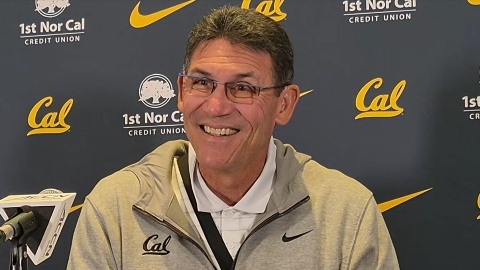
In today's episode, Cal Hall of Fame QB and color analyst Mike Pawlawski talks with new Cal offensive coordinator Jordan Somerville about the new Cal offense.
You can hear the audio podcast on Soundcloud, Spotify, Apple Podcasts or on most podcast streaming services. You can also view the podcast on the video below:
https://soundcloud.com/bear-insider-859421566/ultimate-insider-podcast-e124
Building the New Cal Offense: A Conversation with Offensive Coordinator Jordan Somerville
When you spend your life around quarterbacks and offensive football, you develop a natural curiosity about the people designing the offense. As a former Cal quarterback and now broadcaster, I’ve spent years analyzing the Bears’ offense from the booth and the film room. So when Cal hired Jordan Somerville as the new offensive coordinator under head coach Tosh Lupoi, I wanted to sit down with him and learn how he thinks about the game.
Somerville represents a new generation of offensive minds in college football—young, energetic, and shaped by experience across multiple systems. His coaching journey has taken him from Arizona State to New Mexico, Oregon, and most recently the Tampa Bay Buccaneers. At just 29 years old, he now holds the keys to the Cal offense.
Our conversation revealed a coach who blends modern offensive thinking with a deep belief in leadership, culture, and mindset.
A Different Path to Coaching
Unlike many coaches, Somerville didn’t play college football. But his path into coaching started early.
Growing up as an offensive lineman, he quickly realized that playing at the next level probably wasn’t in the cards. Instead of abandoning the game, he leaned into another role.
“I started coaching youth football when I was in high school,” Somerville told me. “That was when the light bulb clicked. I realized that coaching was what I wanted to do for the rest of my life.”
When he arrived at Arizona State as a student, he immediately pursued an opportunity with the football program. He volunteered as a student assistant for two and a half years before eventually earning a graduate assistant role.
From there, the coaching journey began in earnest.
Stops at New Mexico, Oregon, and eventually Tampa Bay exposed him to multiple offensive philosophies and coaching styles. Each experience added new layers to the way he now approaches building an offense.
It’s a path that mirrors several successful modern coaches.
We talked about names like Mike Leach and Lincoln Riley, two innovative offensive minds who also didn’t follow the traditional path of playing major college football before coaching.
Somerville is part of that same emerging lineage.
Why Quarterbacks?
For many offensive coaches, the quarterback room becomes home. That was certainly true for Somerville.
“The quarterback position is the most important position in sports,” he said. “It’s also the hardest.”
That challenge is what attracted him.
Quarterbacks sit at the intersection of everything that happens on the field—run game, pass game, protections, and defensive recognition. They must process information faster than any other athlete in sports.
“The quarterback is the true center point of all 22 players on the field,” Somerville said. “You’re asked to run the entire show.”
As someone who lived in that world as a quarterback at Cal, I couldn’t agree more.
Most people underestimate the mental demands of the position. Quarterbacks must recognize fronts, identify pressure, understand coverage rotations, and process all of it in seconds.
You have roughly 1.5 seconds to decide and about 2.7 seconds to get the ball out.
That’s why the quarterback room tends to be one of the most cerebral environments in sports.
Coaching the Learner
One of the first things Somerville emphasized was how he approaches teaching quarterbacks.
It starts with understanding how each player learns.
“It’s not about what we know as coaches,” he said. “It’s about what the players can digest, learn, and apply.”
That philosophy applies to the entire offense.
Some players learn visually.
Others need to walk through concepts physically.
Some can absorb information just by hearing it explained.
Somerville believes great coaches adapt to the learner rather than forcing players into one teaching style.
“We go through everything with a fine-tooth comb,” he explained. “How are we presenting information? How do they take notes? How do they process the language?”
That attention to detail allows players to eventually own the offense rather than simply memorize it.
Building an Offensive Identity
For Cal fans, the most pressing question is obvious:
What will the new Cal offense actually look like?
Somerville says the foundation begins with two simple principles:
Ill intent.
Explosive mentality.
For him, the offense must start inside—with the offensive line.
“It starts with ill intent at the line of scrimmage,” he said. “Then it extends to the perimeter.”
Ill intent doesn’t mean reckless football. It means playing aggressively, finishing blocks, and attacking every snap with purpose.
The explosive mentality extends to the skill positions—especially the quarterback.
“It’s about how we approach the play after the snap,” Somerville explained. “How we finish blocks, how we run with the ball, how we attack vertically.”
But the bigger shift he wants isn’t physical.
It’s mental.
“To change something, it has to be a paradigm shift,” he said. “We have to perceive things differently and operate differently.”
Quarterback Confidence
Cal fans will be excited to hear Somerville’s thoughts about quarterback JKS.
He sees a player with rare natural accuracy and fearlessness.
The goal now is helping him play even faster.
“What does he see well? What does he feel comfortable with?” Somerville said. “Then we build from there.”
Confidence is the key.
“With the human soul on fire, anything is possible,” he told me.
That confidence extends beyond the quarterback to the entire offense.
“We want 11 guys taking the field with the mindset that nothing can stop us.”
Ill Intent for a Quarterback
One question I had for Somerville was how the idea of “ill intent” applies to a quarterback.
After all, quarterbacks operate differently than linemen or running backs.
His answer was simple.
It’s about attacking the moment without fear.
“When we’re on vertical routes, the quarterback has the ill intent that he’s going to rip the ball down the field,” Somerville said.
It’s not reckless.
It’s decisive.
“It’s not thinking about what can go wrong. It’s thinking that everything is going to go right.”
That mindset fits well with the natural style of Cal’s quarterback room.
A Young Offensive Coordinator
At 29 years old, Somerville is one of the youngest offensive coordinators in major college football.
That raises an interesting leadership question.
How does a young coordinator establish authority in a room full of older players and coaches?
Somerville doesn’t believe leadership requires being loud.
“I’ve been around plenty of alphas who weren’t loud,” he said.
Instead, he believes leadership starts with authenticity and relationships.
“You have to be true to yourself,” he explained. “Football people can sniff out fake pretty quickly.”
Respect is earned through connection.
He makes it a priority to learn everyone’s names—not just players, but their families.
“Learn their parents’ names. Their wives’ names. Their kids’ names,” he said.
Because football isn’t just about X’s and O’s.
It’s about people.
Operation Before Scheme
During the current phase of the offseason, the offense is focused on something surprisingly basic.
Operation.
Before worrying about complex schematics, the staff wants players comfortable with the mechanics of the offense.
“Can we get 11 guys lined up where they need to be?” Somerville said.
They’re working on:
Huddle procedures
Tempo variations
Communication systems
Offensive language
Only after those fundamentals are mastered will the offense fully expand.
“If the foundation isn’t strong, the rest won’t work,” Somerville said.
Multiple Influences
Somerville’s offense will blend concepts from several places he has coached.
His time in Tampa Bay exposed him to systems derived from the Sean McVay coaching tree, while his time at Oregon provided exposure to modern spread concepts.
That combination should create a flexible offensive approach.
Expect to see:
Formation shifts
Motion packages
Pre-snap indicators for quarterbacks
The goal is to give quarterbacks clues about what the defense is doing.
“We’re trying to create eye violations for the defense,” Somerville explained.
That means forcing defenders to reveal coverage responsibilities before the snap.
Recruiting Philosophy
Somerville is also known as a strong recruiter. When evaluating players, one trait matters above all others. Self-motivation.
“Are you a self-starter?” he said.
In the NIL era, many players are motivated by external rewards. Somerville wants players driven by something deeper.
“What do you do for the love of the game?” he asks recruits.
He often talks about becoming “masters of the mundane.” That means embracing the boring work nobody celebrates.
“The stuff nobody posts on Twitter,” he said. Early morning workouts.
Repetitive drills. Preparation when nobody is watching.
Those habits separate good players from great ones.
The Vision for the Offense
So what will the Cal offense look like when the season arrives? Somerville’s answer focused less on scheme and more on culture.
“You’re going to see an offense that plays for each other,” he said.
An offense that is:
Explosive off the ball
Relentless in effort
Confident in execution
“No highs, no lows,” he said.
Whether up by 40 or down by 40, the mentality will remain the same.
Attack.
Play fast.
Play confident.
“The schematics will take care of themselves,” Somerville said.
But the identity will come from the players.
The Influence of Tosh Lupoi
Somerville also credits head coach Tosh Lupoi with creating the environment that allows the offense to grow.
“He’s given me incredible confidence,” Somerville said.
Lupoi’s defensive background also provides valuable perspective when designing offensive strategies.
“What makes things difficult for a defense?” Somerville asks.
That perspective helps shape how the offense attacks opponents.
Perhaps more importantly, Lupoi sets the energy standard for the entire program.
“He moves around like a volunteer trying to get a job,” Somerville said with a laugh.
That relentless energy spreads throughout the team.
Confidence Cascades
As we wrapped up the conversation, I shared something I often talk about in leadership and performance. It’s called the “Confidence Cascade”. It’s a powerful way to build team culture and it depends on high integrity and high effort.
Belief spreads. Leaders need to create belief withing their players.
When a leader believes in someone, that confidence cascades through the organization.
Quarterbacks believe in their coaches.
Receivers believe in their quarterbacks.
Linemen believe in the players beside them.
Soon the entire team believes in itself.
That’s how winning cultures are built.
And if Jordan Somerville succeeds in creating that culture inside the Cal offense, the Bears may soon have something they’ve been searching for.
An offensive identity.